
Why a court ruling on Amerika Sāmoa's seabed matters to every Pacific person
You may never have heard of the National Marine Fisheries Service. You may never set foot on Tutuila. But what happened in a Honolulu courtroom this week could shape what happens to the ocean our families have lived from for thousands of years.
On 16 November 2026, a US federal judge threw out the environmental approval behind the first deep-sea mining lease sale in American history. It covers more than 31 million acres of seabed off Amerika Sāmoa. The auction was three days away.
The people who stopped it were not a government or a mining company. They were a Samoan community group, Fa‘asao Amerika Samoa, standing with the Conservation Council for Hawai‘i and lawyers from Earthjustice. They took on the most powerful government in the world over waters it controls, and they won the first round.
Here is why that matters, whether you live in Pago Pago, Brisbane, Auckland or anywhere the moana runs through your story.
What just happened, in plain terms
Before the US can auction seabed, its fisheries agency has to check whether the plan could harm endangered species. In February 2026 the agency said the sale was "not likely to adversely affect" them. But it only looked at the first step: mapping and sampling the seafloor.
Judge Jill Otake said that was not good enough. The agency "did not even attempt to consider the potential effects of post-leasing activities," she wrote. In other words, it approved the door opening without asking what walks through it: exploration, testing and full-scale mining.
She called the review "cramped" and "expedited," cancelled the approval outright, and said the agency now "needs to do the bulk of its consultation duty for the first time." The auction is still listed for 19 November (US time), but without a valid approval it may not legally go ahead.
Why it matters #1: the ocean is family, not an empty space
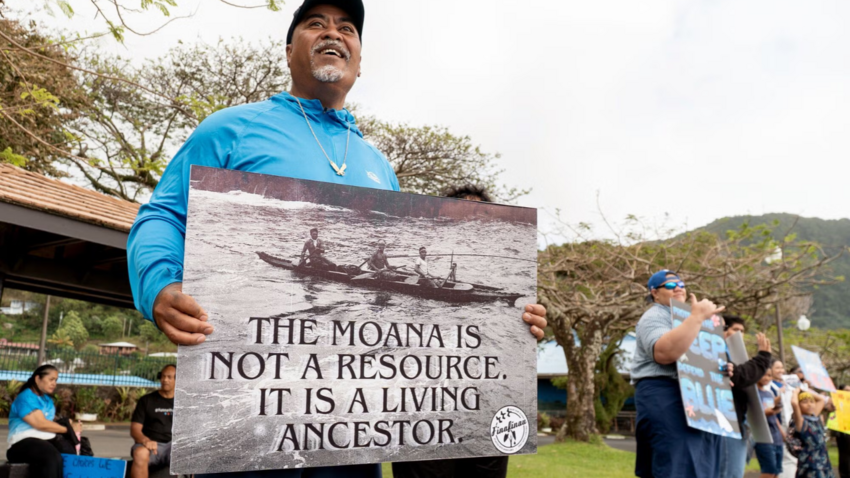
To a mining company, the deep sea is a store of metals. To us, it is kin. "American Samoans share a profound cultural and spiritual bond with the ocean, which Samoans have stewarded for thousands of years," said Seumalu Dr. Elora Raymond of Fa‘asao Amerika Samoa. Many of the species at risk, she said, are sacred to Samoan people.
Think about who lives in these waters. Blue, fin, sei and sperm whales. Five kinds of sea turtle. Hammerhead and oceanic whitetip sharks, giant manta rays, the chambered nautilus and five species of coral. The turtle and the shark are woven into the story of Vaitogi on Tutuila. Tuna, which feed families and carry the territory's economy, swim through here too. And the lease areas sit right beside Rose Atoll, one of the most protected reefs in the Pacific.
Deep-sea mining has never been done at commercial scale anywhere. Nobody can tell you what scraping the seabed will do to these animals, because nobody has done it yet. This ruling says, at minimum, someone has to ask before it starts.
Why it matters #2: Pacific people barely get a say
Amerika Sāmoa already said no. In 2024 the territory banned deep-sea mining in its own waters. The federal sale simply targets the seabed further out, beyond the reach of local law.
Samoans can comment on the plan, but Washington decides. Their delegate in Congress, Aumua Amata Coleman Radewagen, cannot vote on the final passage of bills. "I represent our people, and most of our people are opposed," she said in July. When a community's voice counts for this little, a courtroom becomes one of the few places it can be heard.
Not every leader sees it the same way, and that matters too. Governor Pulaali‘i Nikolao Pula welcomed the sale as a chance to learn what resources exist, stressing that it "is not approval to mine our ocean floor." He pointed to population decline, a narrow economy and shrinking federal funding. That is a real dilemma for small island economies everywhere: how do you build a future for your young people without trading away the ocean they will inherit?
Why it matters #3: our chiefs' agreements are being tested
There is a second case, and it may matter even more. In October, Faleula o le Manu‘atele, a council of matai from the Manu‘a Islands, joined a lawsuit arguing that US law does not allow mineral leasing in the territories at all. They also argue that treaty requirements must be met before any leasing can happen in Amerika Sāmoa.
Manu‘a's chiefs ceded their islands to the United States by deed in 1904. More than a century later, their descendants are asking whether those agreements still mean something. However the court answers, it will say a lot about how much weight Pacific chiefly authority carries in a modern legal system.
Why it matters #4: Samoa is the first, not the last
If this sale had gone through quietly, it would have become the template. The next one is already scheduled: seabed off Guam and the Northern Mariana Islands goes to auction on 16 December. The same agency gave it the same quick approval, and the same lawyers have asked Judge Otake to cancel that one too.
Both Marianas governors want a pause. "We are not a sovereign nation, so we have no control," said Guam's Governor Lou Leon Guerrero. It is a sentence many Pacific people will recognise.
And the Pacific is watching. Fiji is among the nations calling for a precautionary pause on deep-sea mining. Our region knows what happens when outside powers decide our lands and waters are useful to them: we have seen it with phosphate mining and nuclear testing. Whatever happens off Samoa will ripple across the whole Moana Nui.
Why you should keep watching
This is a first-round win, not the end. The US government says the risk at the lease stage is "virtually nonexistent," and the Interior Secretary has said mining permits could come "within months." The agency can redo its review and try again.
Here is what to keep an eye on:
- Whether the 19 November auction goes ahead, gets postponed, or ends up back in court
- The judge's decision on the Marianas sale before 16 December
- The Manu‘a matai case on whether leasing in the territories is lawful at all
Why should you care if you are not from Amerika Sāmoa? Because the ocean does not stop at borders. Because the whales and turtles in these waters travel the whole Pacific. And because a small Samoan community just showed that our voices, backed by the law, can slow down a decision made thousands of kilometres away. Follow this story, share it, and talk about it with your family. The moana is everyone's inheritance.
Sources
- Pasquines, "Federal judge throws out species approval for deep-sea mining sale off American Samoa," 17 November 2026 (supplied)
- Earthjustice, "Court Rules Trump Administration Violated Law in Greenlighting American Samoa Deep-Sea Mining Lease Sale" (supplied); court ruling
- NRDC: Trump Administration Finalizes First U.S. Deep-Sea Mining Lease Sale Off American Samoa
- Malay Mail / AFP on American Samoa's 2024 territorial-waters ban
- Pacific Media Network: 'They can lease the seabed but not our identity'
- Thumbnail: Earthjustice attorney David Henkin, left, and Rudy Bartley, a member of the nonprofit groups Faasao Amerika Samoa and Puipui Measina a Amerika Samoa, take part in the Stand with the Moana demonstration to support and protect the ocean on July 16, 2026 on the Utulei shore in American Samoa. The event was organized by Finafinau, a nonprofit environmental advocacy group. (Gabby Faʻaiʻuaso for Earthjustice)